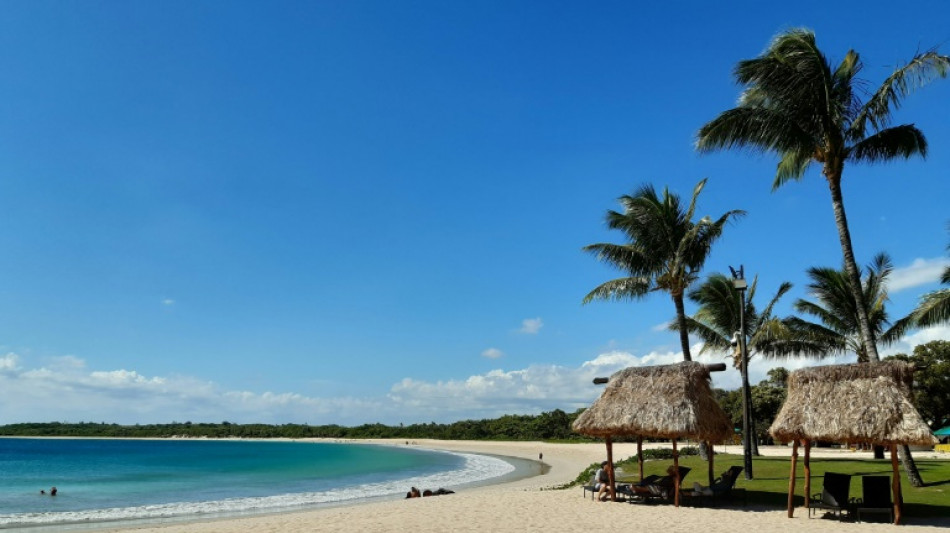
Fiji villagers reject plan for 'Pacific ashtray' in beach paradise / Photo: AILEEN TORRES-BENNETT - AFP/File

 London
 19 °C
19 °C

 Manchester
 17 °C
17 °C
 Glasgow
16 °C
Glasgow
16 °C
 Dublin
20 °C
Dublin
20 °C
 Belfast
19 °C
Belfast
19 °C
 Washington
20 °C
Washington
20 °C
 Denver
 14 °C
14 °C
 Atlanta
22 °C
Atlanta
22 °C
 Dallas
25 °C
Dallas
25 °C
 Houston Texas
 27 °C
27 °C
 New Orleans
26 °C
New Orleans
26 °C
 El Paso
21 °C
El Paso
21 °C
 Phoenix
29 °C
Phoenix
29 °C
 Los Angeles
20 °C
San Diego
21 °C
San Francisco
14 °C
Chicago
16 °C
Minneapolis
10 °C
Seattle
11 °C
Portland
14 °C
Salt Lake City
13 °C
Las Vegas
25 °C
Miami
25 °C
Jacksonville
24 °C
San Antonio
25 °C
Bermuda
Los Angeles
20 °C
San Diego
21 °C
San Francisco
14 °C
Chicago
16 °C
Minneapolis
10 °C
Seattle
11 °C
Portland
14 °C
Salt Lake City
13 °C
Las Vegas
25 °C
Miami
25 °C
Jacksonville
24 °C
San Antonio
25 °C
Bermuda
 27 °C
Nassau
16 °C
Iqaluit
0 °C
Yellowknife
13 °C
Anchorage
27 °C
Nassau
16 °C
Iqaluit
0 °C
Yellowknife
13 °C
Anchorage
 9 °C
Fairbanks
7 °C
Barrow
-2 °C
Calgary
10 °C
Edmonton
9 °C
Fairbanks
7 °C
Barrow
-2 °C
Calgary
10 °C
Edmonton
 23 °C
Winnipeg
8 °C
Goose Bay
9 °C
Halifax
14 °C
Boston
13 °C
Ottawa
8 °C
Toronto
11 °C
Detroit
14 °C
Cleveland
16 °C
New York
17 °C
Baltimore
19 °C
Philadelphia
18 °C
Nuuk (Godthåb)
23 °C
Winnipeg
8 °C
Goose Bay
9 °C
Halifax
14 °C
Boston
13 °C
Ottawa
8 °C
Toronto
11 °C
Detroit
14 °C
Cleveland
16 °C
New York
17 °C
Baltimore
19 °C
Philadelphia
18 °C
Nuuk (Godthåb)
 1 °C
Hong Kong
29 °C
Singapore
27 °C
Melbourne
24 °C
Canberra
11 °C
Adelaide
11 °C
Darwin
28 °C
Perth
18 °C
Fort Worth
23 °C
Honolulu
26 °C
Sydney
14 °C
Johannesburg
22 °C
Dubai
39 °C
Mumbai
1 °C
Hong Kong
29 °C
Singapore
27 °C
Melbourne
24 °C
Canberra
11 °C
Adelaide
11 °C
Darwin
28 °C
Perth
18 °C
Fort Worth
23 °C
Honolulu
26 °C
Sydney
14 °C
Johannesburg
22 °C
Dubai
39 °C
Mumbai
 30 °C
Zürich
20 °C
Tokyo
23 °C
Seoul
24 °C
Delhi
36 °C
Beijing
23 °C
Riyadh
39 °C
Prague
16 °C
Pennsylvania
17 °C
Valletta
27 °C
Manama
36 °C
Warsaw
13 °C
Stockholm
15 °C
30 °C
Zürich
20 °C
Tokyo
23 °C
Seoul
24 °C
Delhi
36 °C
Beijing
23 °C
Riyadh
39 °C
Prague
16 °C
Pennsylvania
17 °C
Valletta
27 °C
Manama
36 °C
Warsaw
13 °C
Stockholm
15 °C
An Australian billionaire's plan to burn rubbish for energy in Fiji amounts to "waste colonialism" and risks spoiling a "beach paradise", villagers and the Pacific nation's UN ambassador said.
Traditional landowner Inoke Tora boarded a bus to the capital Suva on Tuesday with a petition from villagers opposing the $630 million waste-to-energy incinerator, which is forecast to consume 900,000 tonnes of non-recyclable rubbish each year.
The fashion entrepreneur behind the Paris-born Kookai label and an Australian billionaire who made his fortune in rubbish disposal want to build a port and waste incinerator within 15 kilometres (nine miles) of Fiji's tourism gateway Nadi.
The Australian-based duo of Ian Malouf and Rob Cromb have told Fiji's government the project could meet 40 percent of the small nation's electricity needs, cutting its reliance on diesel.
However, an environmental impact statement lodged by their company TNG shows it would also raise Fiji's national emissions by 25 percent.
Residents say the emissions will spoil Fiji's eco-tourism reputation and pose a safety risk with hotels and schools nearby.
"There are hundreds of people living in villages in this place and they fish each day, eat fresh crabs. They call that beach paradise," Tora told AFP by telephone on his way to petition Fiji's prime minister.
"The government should stop this."
Fiji's ambassador to the United Nations, Filipo Tarakinikini, wrote on social media on Monday that the Vuda coast north of Nadi "must not become the Pacific's ashtray".
Ash residue and dioxins would contaminate the food chain, Tarakinikini warned, likening the plan to send up to 700,000 tonnes of non-recyclable rubbish to Fiji each year to "waste colonialism".
- Rejected in Australia -
"Dial-a-Dump" founder Malouf spent seven years trying to get a similar waste-to-energy incinerator approved in Sydney before it was rejected as a risk to human health in 2018, planning and court documents show.
Stephen Bali, then mayor of Blacktown in Sydney, led opposition to the project in his suburb and urged Fiji to seek independent scientific data.
"Gathering up rubbish from Australia, driving it in a diesel truck to port, putting it on a diesel ship to Fiji to be offloaded -- it would be interesting to look at those emissions," Bali, now a lawmaker in the New South Wales state parliament, told AFP.
"We need to deal with our own waste," he said.
Malouf did not respond to AFP's request for comment.
His business partner Cromb, who bought the Paris fashion label Kookai in 2017, said he maintains business links to Fiji, where he was born, because Kookai manufactures clothes there.
Cromb has held community meetings with villagers as the incinerator proposal spurs a backlash.
- Under review -
"There are genuine concerns around environmental safety, transparency, and the scale of the proposal and those concerns are valid and are being taken seriously," Cromb said in a statement sent to AFP.
Energy-from-waste systems "are widely used in jurisdictions with some of the world's highest environmental protections", he said.
"By diverting waste from landfill where it would otherwise produce methane, a significantly more potent greenhouse gas and reducing reliance on fossil fuel-based energy sources, energy-from-waste can contribute to broader lifecycle emissions benefits," he said.
The project would manage waste generated in Fiji, reduce landfill and support the country's energy needs, he said.
"It is not a project intended to import waste from overseas," he said.
However, the plan for a port and incinerator lodged with Fiji's government showed it would feed in local waste as well as waste shipped from Australia and across the region.
Opponents have told the government it would be a breach of a 1998 convention signed by Australia to ship hazardous waste to a Pacific island country.
Fiji's Tourism Minister Vilame Gavoka said tourism across Nadi could be jeopardised by the incinerator.
"Such facilities in other countries are located away from businesses and densely populated areas," his office said.
And Fiji's permanent secretary for environment and climate change, Michael Sivendra, told AFP the project is under review.
Resident Eremasi Matanatabu, a food company manager, said concern over building a waste business in the bay where the first Fijians arrived to shore is widespread.
"It will stick out like a big sore thumb," he said.
A.Ferrara--INP