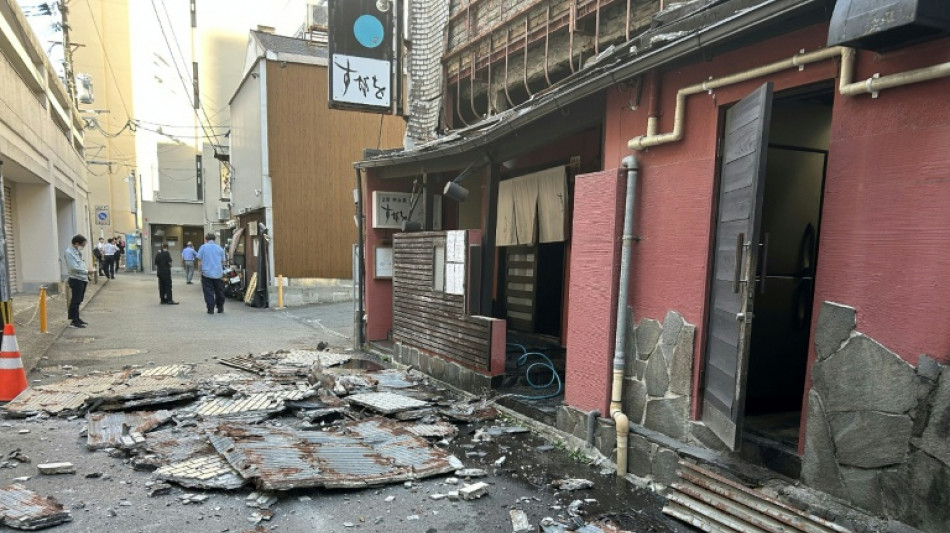
Japan PM says injuries, buildings collapsed in major quake / Photo: STR - JIJI Press/AFP

 London
 22 °C
22 °C

 Manchester
 17 °C
17 °C
 Glasgow
 25 °C
25 °C
 Dublin
18 °C
Dublin
18 °C
 Belfast
16 °C
Belfast
16 °C
 Washington
24 °C
Washington
24 °C
 Denver
16 °C
Denver
16 °C
 Atlanta
28 °C
Atlanta
28 °C
 Dallas
 33 °C
33 °C
 Houston Texas
33 °C
Houston Texas
33 °C
 New Orleans
32 °C
New Orleans
32 °C
 El Paso
24 °C
El Paso
24 °C
 Phoenix
32 °C
Phoenix
32 °C
 Los Angeles
22 °C
San Diego
22 °C
San Francisco
16 °C
Chicago
24 °C
Minneapolis
18 °C
Seattle
14 °C
Portland
14 °C
Salt Lake City
19 °C
Las Vegas
30 °C
Miami
33 °C
Jacksonville
29 °C
San Antonio
32 °C
Bermuda
28 °C
Nassau
21 °C
Iqaluit
5 °C
Yellowknife
6 °C
Anchorage
Los Angeles
22 °C
San Diego
22 °C
San Francisco
16 °C
Chicago
24 °C
Minneapolis
18 °C
Seattle
14 °C
Portland
14 °C
Salt Lake City
19 °C
Las Vegas
30 °C
Miami
33 °C
Jacksonville
29 °C
San Antonio
32 °C
Bermuda
28 °C
Nassau
21 °C
Iqaluit
5 °C
Yellowknife
6 °C
Anchorage
 12 °C
Fairbanks
5 °C
Barrow
-3 °C
Calgary
8 °C
Edmonton
33 °C
Winnipeg
14 °C
Goose Bay
18 °C
Halifax
19 °C
Boston
19 °C
Ottawa
16 °C
Toronto
20 °C
Detroit
22 °C
Cleveland
24 °C
New York
21 °C
Baltimore
23 °C
Philadelphia
22 °C
Nuuk (Godthåb)
6 °C
Hong Kong
29 °C
Singapore
28 °C
Melbourne
31 °C
Canberra
12 °C
Fairbanks
5 °C
Barrow
-3 °C
Calgary
8 °C
Edmonton
33 °C
Winnipeg
14 °C
Goose Bay
18 °C
Halifax
19 °C
Boston
19 °C
Ottawa
16 °C
Toronto
20 °C
Detroit
22 °C
Cleveland
24 °C
New York
21 °C
Baltimore
23 °C
Philadelphia
22 °C
Nuuk (Godthåb)
6 °C
Hong Kong
29 °C
Singapore
28 °C
Melbourne
31 °C
Canberra
 4 °C
Adelaide
4 °C
Adelaide
 11 °C
Darwin
25 °C
Perth
19 °C
Fort Worth
33 °C
Honolulu
25 °C
Sydney
12 °C
Johannesburg
19 °C
Dubai
35 °C
Mumbai
11 °C
Darwin
25 °C
Perth
19 °C
Fort Worth
33 °C
Honolulu
25 °C
Sydney
12 °C
Johannesburg
19 °C
Dubai
35 °C
Mumbai
 26 °C
Zürich
28 °C
Tokyo
23 °C
Seoul
15 °C
Delhi
30 °C
Beijing
20 °C
Riyadh
38 °C
Prague
24 °C
Pennsylvania
21 °C
Valletta
27 °C
Manama
35 °C
Warsaw
19 °C
Stockholm
15 °C
26 °C
Zürich
28 °C
Tokyo
23 °C
Seoul
15 °C
Delhi
30 °C
Beijing
20 °C
Riyadh
38 °C
Prague
24 °C
Pennsylvania
21 °C
Valletta
27 °C
Manama
35 °C
Warsaw
19 °C
Stockholm
15 °C
A major earthquake collapsed buildings and sparked fires in Japan's southwest, Prime Minister Sanae Takaichi said on Tuesday, with broadcaster NHK saying that at least 50 people were taken to hospital.
Television footage on NHK showed several blazes, damaged bridges, a derailed cargo train and cracked roads after the tremor on Kyushu island. The broadcaster reported at least 12 collapsed houses.
The quake at 4:27 pm (0727 GMT) had a magnitude of 7.1, according to the Japan Meteorological Agency, but reached the highest possible level of seven on Japan's Shindo scale of shaking.
The US Geological Survey (USGS) measured the quake -- one of hundreds that strike Japan every year -- at 6.8. The vast majority cause little damage.
"We are still assessing the extent of injuries and property damage, but I have been informed that there have already been several injuries," Takaichi said.
"Power outages and fires are happening in some areas, and roads and bridges have been damaged and buildings collapsed," she said.
The JMA initially issued an alert for a possible tsunami of up to one metre (three feet), but withdrew the warning at around 6:10 pm.
"This earthquake occurred inland, and no tsunami activity has been observed so far. For this reason, we hope to lift the tsunami advisory at a relatively early stage, depending on future sea level conditions," a Japan Meteorological Agency spokesperson said.
No immediate abnormalities were recorded at nuclear power plants, the Nuclear Regulation Authority said.
About 45,000 households and facilities have no power in the Kumamoto region, according to local utility Kyushu Electric Power.
The firm added that three nuclear reactors operating in the region at the time were functioning normally.
- 'Shaking is continuing' -
A local NHK staffer wearing a helmet reported live on air that the shaking was continuing around half an hour after the quake, with the newsroom rocking so violently that it was difficult to remain standing.
"Shaking is continuing as I speak. Including myself, there may be some people who feel their hearts racing," the staffer said.
"When the quake struck, the shaking was so big that I could not stand up. Please be aware of possibility that shaking might continue after this."
Kumamoto was hit by two devastating earthquakes in 2016 -- one of magnitude 6.5, followed two days later by one of magnitude 7.3 -- which killed 273 people and injured more than 2,800.
A quake with a magnitude of 7.2 hit northern Japan on June 25 but caused no deaths or major damage.
Japan is one of the world's most seismically active countries, sitting on top of four major tectonic plates along the western edge of the Pacific "Ring of Fire".
The archipelago, home to around 125 million people, typically experiences hundreds of jolts every year and accounts for about 18 percent of the world's earthquakes.
The vast majority are mild, although the damage they cause varies according to their location and the depth below the Earth's surface at which they strike.
Japan is haunted by the memory of a massive 9.0-magnitude undersea quake in 2011, which triggered a tsunami that killed or left missing around 18,500 people and wrecked the Fukushima nuclear plant.
A tremor measuring 7.7 hit the country's north on April 20 this year, injuring at least 10 people and shaking large buildings in Tokyo.
That prompted authorities to issue a special advisory warning of an increased risk of earthquakes of magnitude 8.0 or stronger.
The advisory was lifted after a week.
tmo-hih-nf-stu/pbt
S.Abato--INP