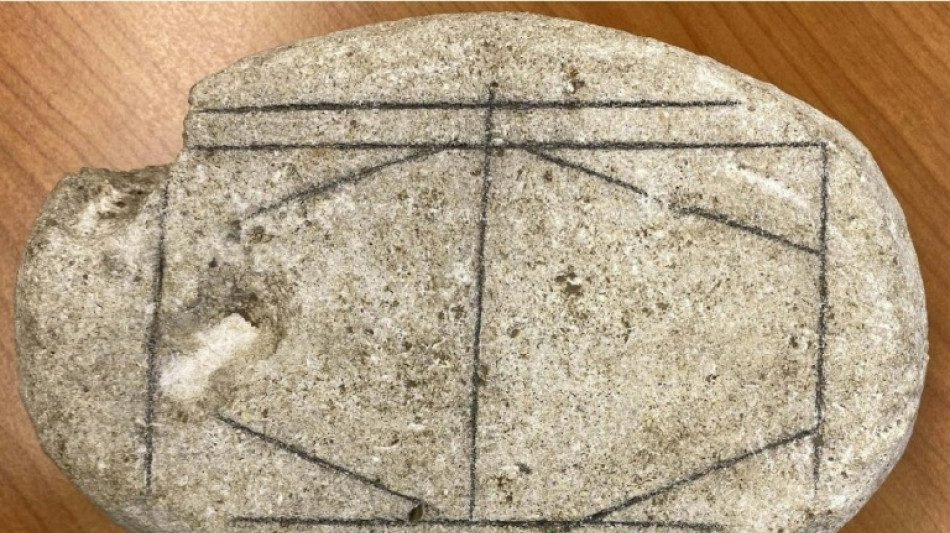
AI cracks Roman-era board game / Photo: Handout - Antiquity/AFP

 London
 20 °C
20 °C

 Manchester
 16 °C
16 °C
 Glasgow
 22 °C
22 °C
 Dublin
17 °C
Dublin
17 °C
 Belfast
15 °C
Belfast
15 °C
 Washington
25 °C
Washington
25 °C
 Denver
19 °C
Denver
19 °C
 Atlanta
32 °C
Atlanta
32 °C
 Dallas
 36 °C
36 °C
 Houston Texas
35 °C
Houston Texas
35 °C
 New Orleans
33 °C
New Orleans
33 °C
 El Paso
27 °C
El Paso
27 °C
 Phoenix
35 °C
Phoenix
35 °C
 Los Angeles
25 °C
San Diego
24 °C
San Francisco
19 °C
Chicago
27 °C
Minneapolis
19 °C
Seattle
15 °C
Portland
17 °C
Salt Lake City
23 °C
Las Vegas
33 °C
Miami
33 °C
Jacksonville
Los Angeles
25 °C
San Diego
24 °C
San Francisco
19 °C
Chicago
27 °C
Minneapolis
19 °C
Seattle
15 °C
Portland
17 °C
Salt Lake City
23 °C
Las Vegas
33 °C
Miami
33 °C
Jacksonville
 28 °C
San Antonio
36 °C
Bermuda
28 °C
Nassau
21 °C
Iqaluit
7 °C
Yellowknife
7 °C
Anchorage
12 °C
Fairbanks
6 °C
Barrow
-1 °C
Calgary
9 °C
Edmonton
35 °C
Winnipeg
15 °C
Goose Bay
18 °C
Halifax
20 °C
Boston
20 °C
Ottawa
17 °C
Toronto
21 °C
Detroit
23 °C
Cleveland
27 °C
New York
22 °C
Baltimore
25 °C
Philadelphia
24 °C
Nuuk (Godthåb)
5 °C
Hong Kong
28 °C
San Antonio
36 °C
Bermuda
28 °C
Nassau
21 °C
Iqaluit
7 °C
Yellowknife
7 °C
Anchorage
12 °C
Fairbanks
6 °C
Barrow
-1 °C
Calgary
9 °C
Edmonton
35 °C
Winnipeg
15 °C
Goose Bay
18 °C
Halifax
20 °C
Boston
20 °C
Ottawa
17 °C
Toronto
21 °C
Detroit
23 °C
Cleveland
27 °C
New York
22 °C
Baltimore
25 °C
Philadelphia
24 °C
Nuuk (Godthåb)
5 °C
Hong Kong
 28 °C
Singapore
28 °C
Melbourne
31 °C
Canberra
28 °C
Singapore
28 °C
Melbourne
31 °C
Canberra
 3 °C
Adelaide
10 °C
Darwin
3 °C
Adelaide
10 °C
Darwin
 24 °C
Perth
18 °C
Fort Worth
36 °C
Honolulu
27 °C
Sydney
12 °C
Johannesburg
14 °C
Dubai
35 °C
Mumbai
24 °C
Perth
18 °C
Fort Worth
36 °C
Honolulu
27 °C
Sydney
12 °C
Johannesburg
14 °C
Dubai
35 °C
Mumbai
 26 °C
Zürich
22 °C
Tokyo
22 °C
Seoul
14 °C
Delhi
30 °C
Beijing
17 °C
Riyadh
34 °C
Prague
19 °C
Pennsylvania
23 °C
Valletta
26 °C
Manama
34 °C
Warsaw
15 °C
Stockholm
14 °C
26 °C
Zürich
22 °C
Tokyo
22 °C
Seoul
14 °C
Delhi
30 °C
Beijing
17 °C
Riyadh
34 °C
Prague
19 °C
Pennsylvania
23 °C
Valletta
26 °C
Manama
34 °C
Warsaw
15 °C
Stockholm
14 °C
A smooth, white stone dating from the Roman era and unearthed in the Netherlands has long baffled researchers.
Now with the help of artificial intelligence, scientists believe they have cracked the mystery: the stone is an ancient board game and they have even guessed the rules.
The circular piece of limestone has diagonal and straight lines cut into it.
Using 3D imaging, scientists discovered some lines were deeper than others, suggesting pieces were moved along them, some more than others.
"We can see wear along the lines on the stone, exactly where you would slide a piece," said Walter Crist, an archaeologist at Leiden University who specialises in ancient games.
Other researchers at Maastricht University then used an artificial intelligence programme that can deduce the rules to ancient games.
They trained this AI, baptised Ludii, with the rules of about 100 ancient games from the same area as the Roman stone.
The computer "produced dozens of possible rule sets. It then played the game against itself and identified a few variants that are enjoyable for humans to play," said Dennis Soemers, from Maastricht University.
They then cross-checked the possible rules with the wear on the stone to uncover the most likely set of movements in the game.
However, Soemers also sounded a note of caution.
"If you present Ludii with a line pattern like the one on the stone, it will always find game rules. Therefore, we cannot be sure that the Romans played it in precisely that way," he said.
The aim of the "deceptively simple but thrilling strategy game" was to hunt and trap the opponent's pieces in as few moves as possible.
The research and the possible rules were published in the journal Antiquity.
D.Ricci--INP