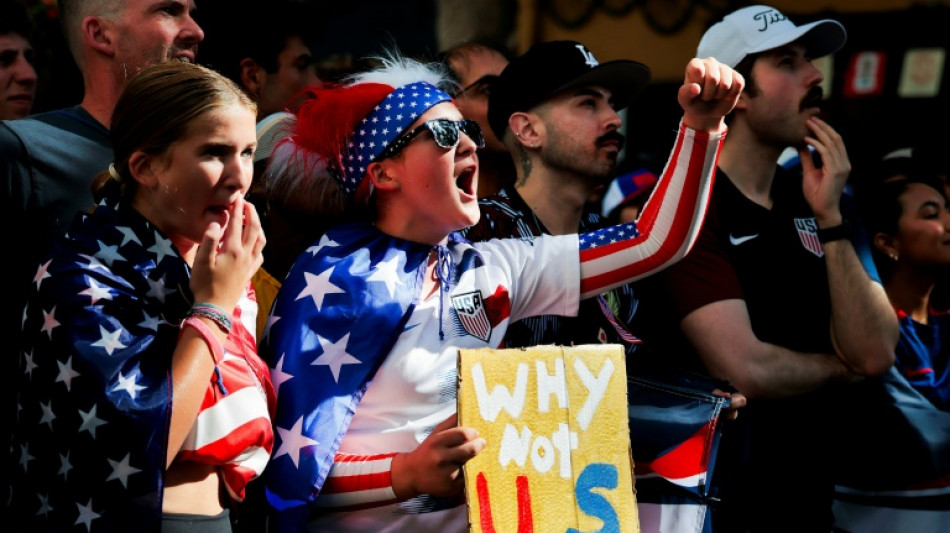
'Country Roads' stars as unofficial US anthem at World Cup / Photo: Heather Diehl - GETTY IMAGES NORTH AMERICA/AFP/File

 London
 18 °C
18 °C

 Manchester
16 °C
Manchester
16 °C
 Glasgow
 12 °C
12 °C
 Dublin
16 °C
Dublin
16 °C
 Belfast
15 °C
Belfast
15 °C
 Washington
24 °C
Washington
24 °C
 Denver
24 °C
Denver
24 °C
 Atlanta
 23 °C
23 °C
 Dallas
30 °C
Dallas
30 °C
 Houston Texas
 28 °C
28 °C
 New Orleans
27 °C
New Orleans
27 °C
 El Paso
 23 °C
23 °C
 Phoenix
35 °C
Phoenix
35 °C
 Los Angeles
21 °C
San Diego
21 °C
San Francisco
Los Angeles
21 °C
San Diego
21 °C
San Francisco
 15 °C
Chicago
14 °C
Minneapolis
11 °C
Seattle
14 °C
Portland
15 °C
Salt Lake City
20 °C
Las Vegas
32 °C
Miami
25 °C
Jacksonville
25 °C
San Antonio
28 °C
Bermuda
27 °C
Nassau
22 °C
Iqaluit
5 °C
Yellowknife
8 °C
Anchorage
11 °C
Fairbanks
8 °C
Barrow
1 °C
Calgary
7 °C
Edmonton
23 °C
Winnipeg
8 °C
Goose Bay
17 °C
Halifax
19 °C
Boston
19 °C
Ottawa
14 °C
Toronto
14 °C
Detroit
14 °C
Cleveland
17 °C
New York
23 °C
Baltimore
24 °C
Philadelphia
23 °C
Nuuk (Godthåb)
5 °C
Hong Kong
15 °C
Chicago
14 °C
Minneapolis
11 °C
Seattle
14 °C
Portland
15 °C
Salt Lake City
20 °C
Las Vegas
32 °C
Miami
25 °C
Jacksonville
25 °C
San Antonio
28 °C
Bermuda
27 °C
Nassau
22 °C
Iqaluit
5 °C
Yellowknife
8 °C
Anchorage
11 °C
Fairbanks
8 °C
Barrow
1 °C
Calgary
7 °C
Edmonton
23 °C
Winnipeg
8 °C
Goose Bay
17 °C
Halifax
19 °C
Boston
19 °C
Ottawa
14 °C
Toronto
14 °C
Detroit
14 °C
Cleveland
17 °C
New York
23 °C
Baltimore
24 °C
Philadelphia
23 °C
Nuuk (Godthåb)
5 °C
Hong Kong
 27 °C
Singapore
33 °C
Melbourne
24 °C
Canberra
20 °C
Adelaide
16 °C
Darwin
27 °C
Singapore
33 °C
Melbourne
24 °C
Canberra
20 °C
Adelaide
16 °C
Darwin
 32 °C
Perth
22 °C
Fort Worth
29 °C
Honolulu
25 °C
Sydney
25 °C
Johannesburg
32 °C
Perth
22 °C
Fort Worth
29 °C
Honolulu
25 °C
Sydney
25 °C
Johannesburg
 16 °C
Dubai
36 °C
Mumbai
30 °C
Zürich
16 °C
Tokyo
30 °C
Seoul
27 °C
Delhi
33 °C
Beijing
26 °C
Riyadh
37 °C
Prague
15 °C
Pennsylvania
22 °C
Valletta
24 °C
Manama
36 °C
Warsaw
15 °C
Stockholm
11 °C
16 °C
Dubai
36 °C
Mumbai
30 °C
Zürich
16 °C
Tokyo
30 °C
Seoul
27 °C
Delhi
33 °C
Beijing
26 °C
Riyadh
37 °C
Prague
15 °C
Pennsylvania
22 °C
Valletta
24 °C
Manama
36 °C
Warsaw
15 °C
Stockholm
11 °C
At this World Cup, the host US team's stirring unofficial anthem is...a 1971 folk song?
John Denver's "Take Me Home, Country Roads" has been an unexpected hit among fans, with US matches culminating in 70,000-strong sing-alongs.
Evoking a kinder, gentler America of a bygone era, the ringing renditions have stirred emotions in a country riven by sharp political division under President Donald Trump.
"You can all kind of unite under how it's, you know, America the beautiful and everyone can kind of sing it in harmony no matter who you are," said US fan Drew Bastinelli, who came from Oregon to attend celebrations in Washington for America's 250th birthday.
Packed stadiums singing as one about home being "the place I belong" feels like a breath of fresh air at a time when Americans are deeply anxious over concerns like inflation, health care and an unpopular war with Iran.
Trump-backed "Freedom 250" festivities in Washington have drawn partisan crowds, with thin turnout for a much-touted Great American State Fair on the National Mall. World Cup stadiums, in contrast, have been filled day after day with jubilant fans.
The "Country Roads" appeal lies in the way it conveys "a kinder, simpler era with less conflict and division," said Doug Hartmann, a sociology professor at the University of Minnesota.
"It is not just nostalgia that is at work in this song but also its ambiguity, its vagueness -- the fact that 'country roads' and 'home' are not clearly defined...means that everyone can hear and place and feel themselves therein."
- 'Impossible not to sing' -
The song's starring role at this World Cup wasn't completely random. US Soccer had submitted to FIFA a postgame playlist that also included Bon Jovi's "Livin' on a Prayer" and Neil Diamond's "Sweet Caroline."
"We were looking for songs that were both representative of American artists and would be great sing-alongs for the crowd," US team spokesman Michael Kammarman said.
With England claiming "Sweet Caroline" first, World Cup 2026 executive Amy Hopfinger chose the well-known John Denver song to close out the June 19 US 2-0 win over Australia.
As the first notes played, the sellout crowd of 66,925 started singing, quickly drowning out the loudspeakers.
A similarly passionate serenade followed the victory over Bosnia and Herzegovina on July 1 that sent the Americans into the round of 16, a game watched by a record 33.5 million US viewers.
Coach Mauricio Pochettino was seen pumping his fist and singing along with gusto.
"I am 200 percent Argentine," he said after the match. "I think when you feel part of something bigger that we are building here...I enjoy being part of that amazing project."
"When that song started to sound in the stadium, it's impossible not to sing," he said. "It's an amazing song. It's very emotional."
- A religious experience -
Such a response is called "collective effervescence," said Jeffrey Montez de Oca, a sociology professor at the University of Colorado in Colorado Springs.
"When singing in a stadium with thousands of other people, you lose yourself in the crowd and feel like you are part of something larger than yourself," he said. "It is akin to a religious experience."
With a diverse group of players representing the spectrum of immigration to the US, Americans are rallying around the team, traditionally a World Cup disappointment.
"The team's diversity, and the strength that this diversity engenders, is symbolically important amid a moment of sharp political backlash in the US over basic rights and freedoms," said Jules Boykoff, a political science professor at Pacific University.
No matter whether there will be more American wins at the World Cup to bring on another take of the John Denver classic, "Country Roads" has already cemented its place in the country's burgeoning football culture.
The song is being played at the tournament even when the US team is not on the pitch.
"Everyone loves that song," said Andy Byford, an Englishman in St Petersburg, Florida who joined in after England-Ghana.
He called the sing-along "a classic American experience."
F.Ciambrone--INP