Lithania Takes EU Presidency with Focus on Competitiveness and Security
 London
 5 °C
 Manchester
 4 °C
 Glasgow
2 °C
 Dublin
 7 °C
 Belfast
7 °C
 Washington
9 °C
 Denver
13 °C
 Atlanta
6 °C
 Dallas
 13 °C
 Houston Texas
12 °C
 New Orleans
11 °C
 El Paso
 8 °C
 Phoenix
16 °C
 Los Angeles
20 °C
San Diego
20 °C
San Francisco
12 °C
Chicago
5 °C
Minneapolis
0 °C
Seattle
9 °C
Portland
 11 °C
Salt Lake City
6 °C
Las Vegas
13 °C
Miami
 23 °C
Jacksonville
13 °C
San Antonio
12 °C
Bermuda
26 °C
Nassau
12 °C
Iqaluit
 -16 °C
Yellowknife
-9 °C
Anchorage
-4 °C
Fairbanks
 -14 °C
Barrow
-8 °C
Calgary
5 °C
Edmonton
4 °C
Winnipeg
0 °C
Goose Bay
2 °C
Halifax
15 °C
Boston
11 °C
Ottawa
4 °C
Toronto
 4 °C
Detroit
4 °C
Cleveland
4 °C
New York
13 °C
Baltimore
10 °C
Philadelphia
12 °C
Nuuk (Godthåb)
-7 °C
Hong Kong
22 °C
Singapore
 28 °C
Melbourne
18 °C
Canberra
18 °C
Adelaide
19 °C
Darwin
27 °C
Perth
 18 °C
Fort Worth
13 °C
Honolulu
19 °C
Sydney
22 °C
Johannesburg
24 °C
Dubai
28 °C
Mumbai
29 °C
Zürich
1 °C
Tokyo
13 °C
Seoul
8 °C
Delhi
15 °C
Beijing
-2 °C
Riyadh
23 °C
Prague
-1 °C
Pennsylvania
8 °C
Valletta
19 °C
Manama
25 °C
Warsaw
0 °C
Stockholm
0 °C
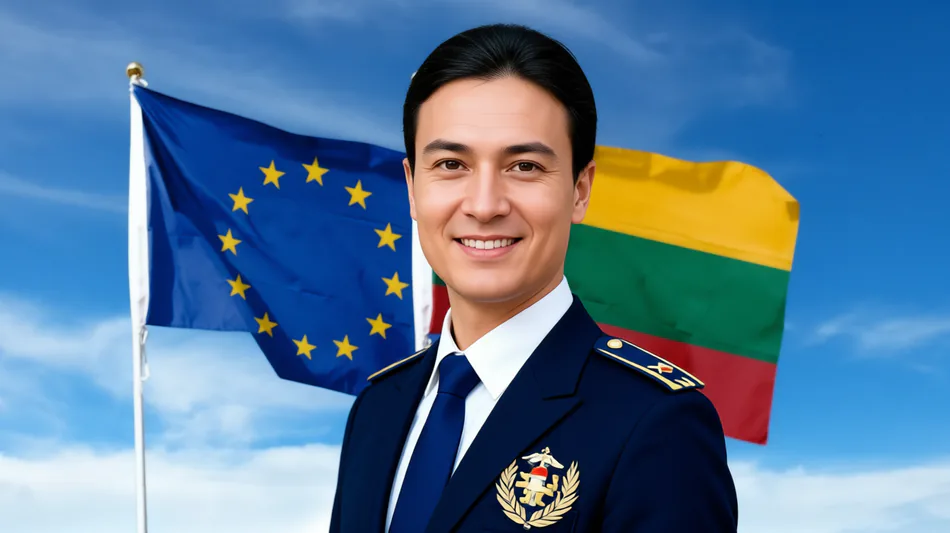
Lithuania is set to assume the European Union’s rotating presidency on January 1, succeeding Ireland. The Baltic state will lead the bloc through June with a primary mandate to address economic competitiveness, industrial growth, and security challenges amid ongoing geopolitical tensions.
Lithuania is preparing to take over the European Union’s rotating presidency on January 1, succeeding Ireland as its term concludes on December 31. The small Baltic state will hold the helm until the end of June, positioning itself at the center of critical discussions regarding wars, energy crises, and climate change mitigation.
The incoming presidency faces immediate pressure to translate broad European competitiveness ambitions into tangible improvements. Ahead of the handover, business leaders convened in Vilnius to outline their expectations for the six-month term. The meeting was hosted by the Lithuanian Confederation of Industrialists (LPK) and attended by Prime Minister Mindaugas Sinkevičius and Minister of Economy and Innovation Edvinas Grikšas.
During the gathering, participants exchanged views with Andrius Kubilius, the EU Commissioner for Defence and Space. The dialogue underscored the urgency of addressing regulatory burdens and fostering an environment conducive to investment.
Maciej Witucki, President of BusinessEurope, emphasized that a robust economy is fundamental to supporting Ukraine and achieving Europe’s security, environmental, and social objectives. However, he warned that the future of European industry remains precarious due to a lack of urgency in delivering real change.
"The EU must take decisive action to strengthen competitiveness, facilitate investment, scale innovation and tackle unfair competition," Witucki said. He identified reducing regulatory burdens as the most cost-effective method for supporting European companies. Witucki called on EU institutions to honor promises to halt the addition of new burdens and accelerate the simplification of existing legislation.
Witucki specifically urged the upcoming Lithuanian Presidency to advance proposals outlined in BusinessEurope’s Omnibook, noting that only 7% of these recommendations have been addressed so far. He also highlighted the importance of the Multiannual Financial Framework (MFF), the EU’s long-term budget currently under discussion by European Council leaders in Brussels.
According to Witucki, the MFF must be structured to strengthen competitiveness, leverage private investment, and concentrate resources where European action delivers the greatest added value. He cautioned that cutting competitiveness funding or introducing new company taxes would undermine these strategic objectives.
Vidmantas Janulevičius, Vice-President of BusinessEurope and President of the LPK, reinforced the link between industrial capacity and national resilience. He stated that Europe’s competitiveness is built within its companies, factories, laboratories, and industrial communities.
Janulevičius noted that when companies decide where to locate new production lines, they require confidence in affordable and predictable energy, access to financing, a skilled workforce, and a functioning Single Market. He counted on the Lithuanian Presidency to collaborate with Member States to turn competitiveness ambitions into concrete improvements in the business environment.
Beyond economic performance, Janulevičius argued that competitiveness is the foundation of Europe’s resilience, strategic autonomy, and security. He asserted that the industrial capacity powering the economy also enables the protection of citizens, support for Ukraine, and the strengthening of defense capabilities.
As governments increase defense spending, Janulevičius argued that public investment and procurement must help European companies scale up production, develop critical technologies, and create high-quality jobs. He emphasized that Europe’s resilience depends on the strength of all its regions, describing investment in industrial bases, energy, transport infrastructure, connectivity, and innovation as strategic investments for the entire Union.
"Stronger and more competitive eastern regions mean a more resilient and more secure European Union," Janulevičius concluded.
S.Abato--INP