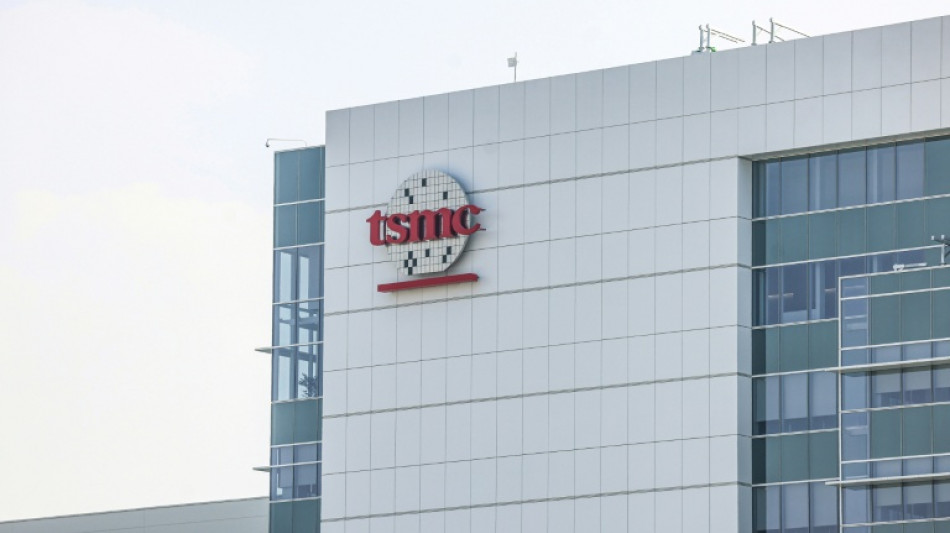
Taiwan chipmaker TSMC to invest another $100bn in Arizona fabs / Photo: I-Hwa Cheng - AFP/File

 London
 23 °C
23 °C

 Manchester
20 °C
Manchester
20 °C
 Glasgow
 13 °C
13 °C
 Dublin
18 °C
Dublin
18 °C
 Belfast
18 °C
Belfast
18 °C
 Washington
 16 °C
16 °C
 Denver
 25 °C
25 °C
 Atlanta
29 °C
Atlanta
29 °C
 Dallas
 35 °C
35 °C
 Houston Texas
35 °C
Houston Texas
35 °C
 New Orleans
31 °C
New Orleans
31 °C
 El Paso
29 °C
El Paso
29 °C
 Phoenix
35 °C
Phoenix
35 °C
 Los Angeles
25 °C
San Diego
25 °C
San Francisco
16 °C
Chicago
16 °C
Minneapolis
17 °C
Seattle
18 °C
Portland
18 °C
Salt Lake City
22 °C
Las Vegas
27 °C
Miami
31 °C
Jacksonville
31 °C
San Antonio
33 °C
Bermuda
31 °C
Nassau
19 °C
Iqaluit
2 °C
Yellowknife
14 °C
Anchorage
6 °C
Fairbanks
3 °C
Barrow
3 °C
Calgary
19 °C
Edmonton
23 °C
Winnipeg
Los Angeles
25 °C
San Diego
25 °C
San Francisco
16 °C
Chicago
16 °C
Minneapolis
17 °C
Seattle
18 °C
Portland
18 °C
Salt Lake City
22 °C
Las Vegas
27 °C
Miami
31 °C
Jacksonville
31 °C
San Antonio
33 °C
Bermuda
31 °C
Nassau
19 °C
Iqaluit
2 °C
Yellowknife
14 °C
Anchorage
6 °C
Fairbanks
3 °C
Barrow
3 °C
Calgary
19 °C
Edmonton
23 °C
Winnipeg
 18 °C
Goose Bay
15 °C
Halifax
16 °C
Boston
17 °C
Ottawa
16 °C
Toronto
16 °C
Detroit
17 °C
Cleveland
18 °C
New York
19 °C
Baltimore
16 °C
Philadelphia
18 °C
Nuuk (Godthåb)
5 °C
Hong Kong
28 °C
Singapore
25 °C
Melbourne
31 °C
Canberra
10 °C
Adelaide
12 °C
Darwin
25 °C
Perth
13 °C
Fort Worth
34 °C
Honolulu
28 °C
Sydney
14 °C
Johannesburg
17 °C
Dubai
35 °C
Mumbai
18 °C
Goose Bay
15 °C
Halifax
16 °C
Boston
17 °C
Ottawa
16 °C
Toronto
16 °C
Detroit
17 °C
Cleveland
18 °C
New York
19 °C
Baltimore
16 °C
Philadelphia
18 °C
Nuuk (Godthåb)
5 °C
Hong Kong
28 °C
Singapore
25 °C
Melbourne
31 °C
Canberra
10 °C
Adelaide
12 °C
Darwin
25 °C
Perth
13 °C
Fort Worth
34 °C
Honolulu
28 °C
Sydney
14 °C
Johannesburg
17 °C
Dubai
35 °C
Mumbai
 29 °C
Zürich
15 °C
Tokyo
23 °C
Seoul
18 °C
Delhi
28 °C
Beijing
19 °C
Riyadh
34 °C
Prague
29 °C
Zürich
15 °C
Tokyo
23 °C
Seoul
18 °C
Delhi
28 °C
Beijing
19 °C
Riyadh
34 °C
Prague
 13 °C
Pennsylvania
17 °C
Valletta
26 °C
Manama
34 °C
Warsaw
12 °C
Stockholm
11 °C
13 °C
Pennsylvania
17 °C
Valletta
26 °C
Manama
34 °C
Warsaw
12 °C
Stockholm
11 °C
Taiwanese chipmaker TSMC will invest an additional $100 billion in the US state of Arizona, the company said Thursday, as it reported a record quarterly net profit on the back of massive demand for AI hardware.
TSMC, the biggest contract maker of microchips used in everything from Apple phones to Nvidia processors, has been a major beneficiary of the global AI race.
Governments and tech giants are pouring huge sums into building data centres that can train and run AI tools such as chatbots, image generators and agents that can execute tasks.
This has turbocharged business for chipmakers such as TSMC, creating shortages and sending prices soaring.
"The AI megatrend continues to drive the need for more and more computation," chairman CC Wei told an earnings call.
"We now expect our full-year 2026 revenue growth to be slightly above 40 percent year-over-year in US dollar terms."
TSMC's net profit for April to June surged 77.4 percent year-on-year to NT$706.6 billion (US$22 billion), smashing analyst estimates of NT$624.4 billion.
The result also beat its previous quarterly record of NT$572.48 billion in the first three months of 2026.
Quarterly revenue rose 36 percent to NT$1.3 trillion.
TSMC will spend an additional $100 billion building "four or more" fabs in Arizona, taking the company's total investment plans in the United States to $265 billion.
"This is to build several or more semiconductor logic wafer fabs for 2-nanometer and below technologies as well as advanced packaging fabs," Wei said.
Chief financial officer Wendell Huang said TSMC will increase its 2026 capital expenditure budget to between $60 and $64 billion "as we continue to invest heavily to support our customers' growth".
Ahead of the results, Counterpoint Research senior analyst William Li said TSMC's surge in revenue showed "AI infrastructure investment remains exceptionally strong despite macro uncertainty."
"Demand for AI GPUs, AI ASICs and advanced packaging continues to exceed expectations," Li told AFP.
Li said: "EUV (extreme ultra-violet lithography tools) supply constraints and overseas fab investments may limit capacity expansion and weigh on margins in the near term."
Concerns about overstretched valuations in the tech sector have fuelled fears of a market bubble, along with questions over when the eye-watering sums being spent on AI will reap returns.
But Omdia principal analyst Simon Chen said those fears were "overstated".
"The demand we see is structural, backed by massive, tangible capital expenditures from hyperscalers," Chen said.
F.Criscuolo--INP