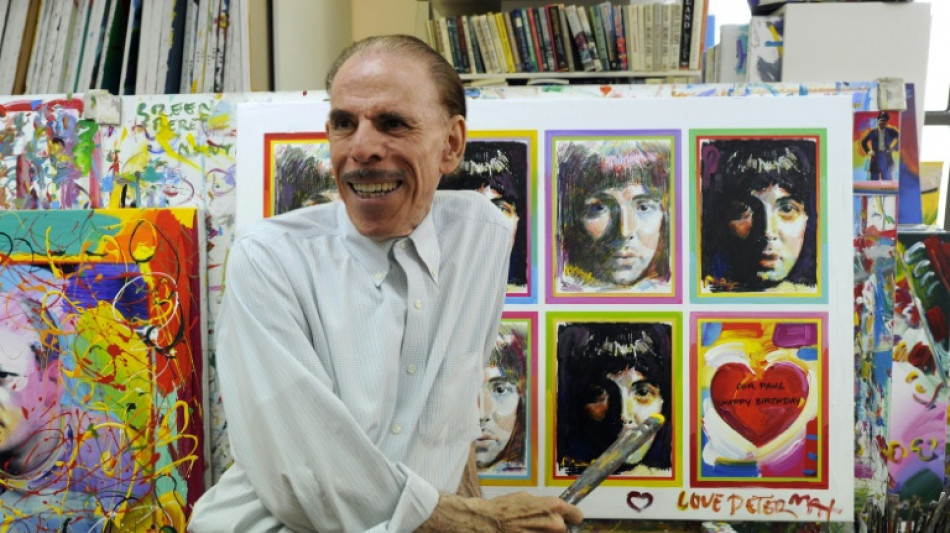
Counterculture pop artist Peter Max dies at 88: US media / Photo: Timothy A. CLARY - AFP/File
 London
 14 °C
14 °C
 Manchester
 14 °C
14 °C
 Glasgow
13 °C
Glasgow
13 °C
 Dublin
 12 °C
12 °C
 Belfast
12 °C
Belfast
12 °C
 Washington
 22 °C
22 °C
 Denver
19 °C
Denver
19 °C
 Atlanta
23 °C
Atlanta
23 °C
 Dallas
30 °C
Dallas
30 °C
 Houston Texas
29 °C
Houston Texas
29 °C
 New Orleans
 28 °C
28 °C
 El Paso
23 °C
El Paso
23 °C
 Phoenix
24 °C
Phoenix
24 °C
 Los Angeles
20 °C
San Diego
21 °C
San Francisco
16 °C
Chicago
20 °C
Minneapolis
Los Angeles
20 °C
San Diego
21 °C
San Francisco
16 °C
Chicago
20 °C
Minneapolis
 14 °C
Seattle
15 °C
Portland
18 °C
Salt Lake City
23 °C
Las Vegas
28 °C
Miami
26 °C
Jacksonville
14 °C
Seattle
15 °C
Portland
18 °C
Salt Lake City
23 °C
Las Vegas
28 °C
Miami
26 °C
Jacksonville
 25 °C
San Antonio
28 °C
Bermuda
27 °C
Nassau
22 °C
Iqaluit
3 °C
Yellowknife
6 °C
Anchorage
11 °C
Fairbanks
7 °C
Barrow
-2 °C
Calgary
7 °C
Edmonton
24 °C
Winnipeg
10 °C
Goose Bay
16 °C
Halifax
18 °C
Boston
20 °C
Ottawa
14 °C
Toronto
17 °C
Detroit
18 °C
Cleveland
22 °C
New York
23 °C
Baltimore
21 °C
Philadelphia
21 °C
Nuuk (Godthåb)
5 °C
Hong Kong
30 °C
Singapore
33 °C
Melbourne
28 °C
Canberra
25 °C
San Antonio
28 °C
Bermuda
27 °C
Nassau
22 °C
Iqaluit
3 °C
Yellowknife
6 °C
Anchorage
11 °C
Fairbanks
7 °C
Barrow
-2 °C
Calgary
7 °C
Edmonton
24 °C
Winnipeg
10 °C
Goose Bay
16 °C
Halifax
18 °C
Boston
20 °C
Ottawa
14 °C
Toronto
17 °C
Detroit
18 °C
Cleveland
22 °C
New York
23 °C
Baltimore
21 °C
Philadelphia
21 °C
Nuuk (Godthåb)
5 °C
Hong Kong
30 °C
Singapore
33 °C
Melbourne
28 °C
Canberra
 15 °C
Adelaide
18 °C
Darwin
15 °C
Adelaide
18 °C
Darwin
 35 °C
Perth
25 °C
Fort Worth
29 °C
Honolulu
27 °C
Sydney
18 °C
Johannesburg
18 °C
Dubai
35 °C
Mumbai
31 °C
Zürich
12 °C
Tokyo
25 °C
Seoul
27 °C
Delhi
31 °C
Beijing
30 °C
Riyadh
34 °C
Prague
13 °C
Pennsylvania
21 °C
Valletta
23 °C
Manama
37 °C
Warsaw
13 °C
Stockholm
14 °C
35 °C
Perth
25 °C
Fort Worth
29 °C
Honolulu
27 °C
Sydney
18 °C
Johannesburg
18 °C
Dubai
35 °C
Mumbai
31 °C
Zürich
12 °C
Tokyo
25 °C
Seoul
27 °C
Delhi
31 °C
Beijing
30 °C
Riyadh
34 °C
Prague
13 °C
Pennsylvania
21 °C
Valletta
23 °C
Manama
37 °C
Warsaw
13 °C
Stockholm
14 °C
Pop artist Peter Max, whose cheery psychedelic creations helped define the counterculture aesthetic in the 1960s, died on Monday, US media reported. He was 88.
"We will remember his extraordinary creativity, his warmth, his curiosity and the way he saw beauty and possibility everywhere," his son Adam Max said in a statement to ABC News.
"His art became part of American culture, but the man behind that art -- the father we knew and loved -- is the person we will miss most."
During his decades-long career, Max created brightly colored graphic images and was credited with capturing the essence of the 1960s "summer of love" and psychedelia.
"I see everything through rainbow eyes," he once told ABC.
Max had long suffered from dementia and died at a hospital, the New York Times reported.
His art appeared on millions of posters -- often the trippy day-glow variety that adorned college dorm rooms -- and numerous magazine covers, as well as government-commissioned welcome murals at borders and a postage stamp, according to his website.
A prolific artist, Max created marketable work that was licensed for many consumer products, from shower curtains to planes and cruise ships, and even a line of "art clocks" commissioned by General Electric.
He also created the logo for MTV in the 1980s, along with posters for the 1994 World Cup soccer tournament, the Super Bowl and the New Orleans Jazz Festival.
- Vegetarian teetotaler -
Born Peter Max Finkelstein in Berlin in 1937, his family left Germany during the rise of the Nazis, traveling through Asia, the Middle East and Paris before entering the United States in 1953, settling in New York City when he was 16.
He studied art at New York's prestigious School for Visual Arts and the Pratt Institute before finding work as a graphic artist and opening his own design studio.
"Max, a vegetarian and a teetotaler who expanded his consciousness through yoga, not drugs, was one of the most visible and successful artists of his time," the Times said.
But success brought its challenges later in his career.
In 1998, Max was sentenced to community service teaching art in Harlem and a $30,000 fine after prosecutors charged him with concealing $714,000 in income from art sales between 1988 and 1991.
In his plea, Max acknowledged bartering art for real estate and hiding income to buy real estate in Southampton, New York, the US Virgin Islands and upstate New York.
In the last decade, disputes over his treatment and ownership of his art landed in court and became tabloid fodder, with the artist's family and friends "trading lurid allegations of kidnapping, hired goons, attempted murder" and moneymaking schemes, the Times reported.
One major source of income and lawsuits has reportedly been in champagne-fueled art auctions on board major cruise lines, including Royal Caribbean, Carnival and Norwegian.
But those sales drew lawsuits from buyers who said the art they received didn't meet their expectations.
Speaking to the Times in 2019, Max said he was "wowed by the universe."
"I love color. I love painting. I love shapes. I love composition. I love the people all around me. I'm adoring it all. My legacy is in the hands of other people."
S.Urgo--INP